



Description
Longjing Cha PDO is a green tea made from fresh tea leaves which is marketed in 6 different grades of quality.
Production Area
The production and processing of Longjing Cha PDO takes place in the Province of Zhejiang, in the areas of Xihu, Qiantang and Yuezhou, mainly in the drainage basins of the Qiantang River and Cao'e River, surrounded by mountains, hills, rivers and lakes.
Production Method
The tea plants, cultivated in red or yellow soil, produce a high yield of buds which grow vigorously and can be harvested several times. The best harvesting time is that between Qing Ming and Grain Raing (from April 5th to 21st), when the tea leaves that are destined for high quality grades are harvested. There are three major principles in the picking of Longjing cha: early, tender and diligent. Processing entails slight withering, roasting, cooling and moistening. This takes place in five stages, where the processes of roasting and cooling are alternated. The so-called "roasting techniques" are made up of particular hand movements that give the tea leaves their particular flat, smooth and straight appearance: shaking, pushing, flinging, pressing in one direction, rubbing, knocking, scratching, pressing and grinding. However, today many producers use mechanical roasting.
Appearance and Flavour
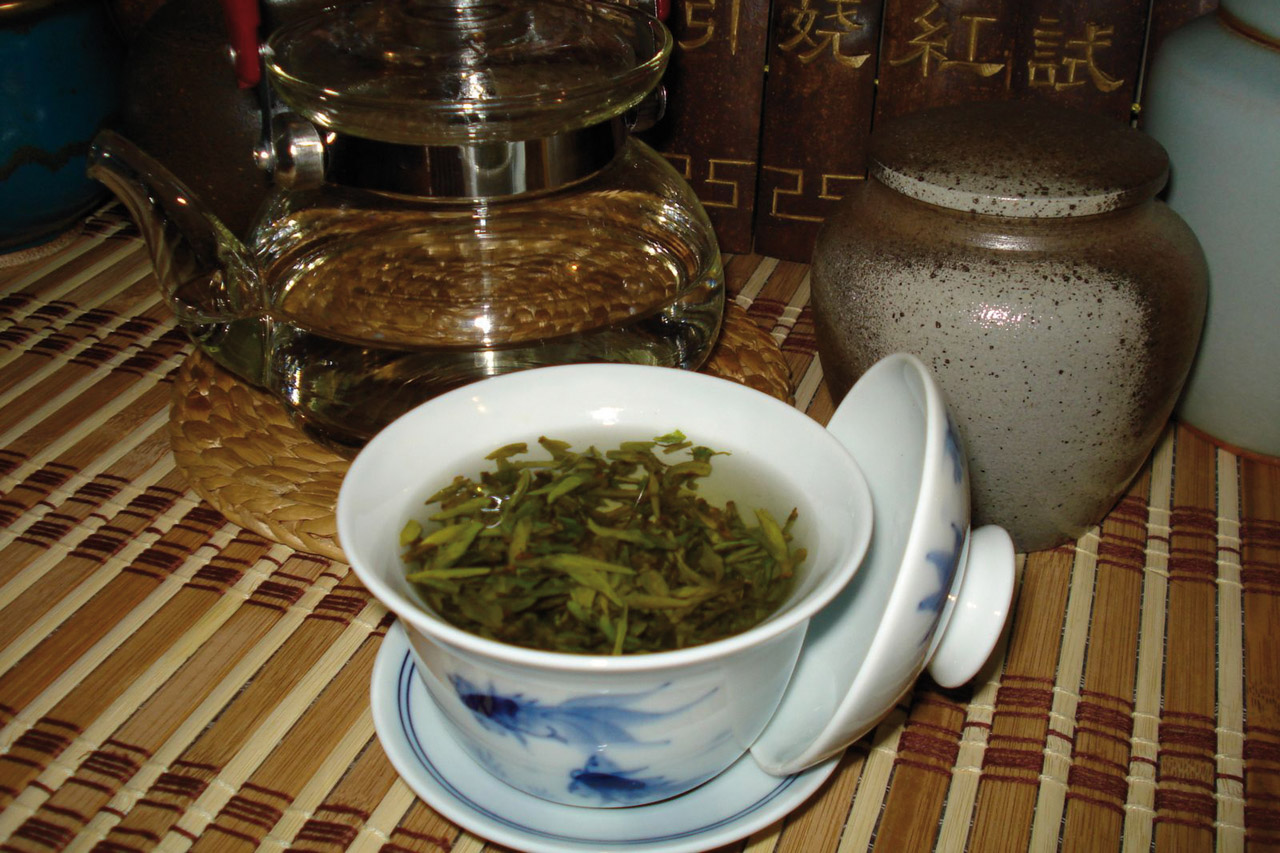
The shape, colour and aroma of the Longjing Cha PDO leaves vary according to the quality grade of the tea. The leaves of Special quality are smooth, flat and straight while the leaves of Grade V are less flat and thicker. The colour varies from light green and fresh (Special) to dark green (Grade V); the aroma ranges from mild to a long lasting fragrance while the taste is brisk and sweet in the higher quality grades and relatively pure and mellow in the lower grades (Grades IV and V).Even the colour of the infusion is variable: in the Special quality it is light green and bright, while Grades IV and V are more yellowish.
History
The name "Longjing" means "Dragon Well" and originates from a small village in the prefecture of Hangzhou in the Province of Zhengjiang. Ancient local populations believed that there was a dragon that was capable of influencing the rain and they dedicated a temple to it called "Longjing". Tea cultivation in this territory began more than 1000 years ago. The name "Longjing Cha" dates back to the Song dynasty, but it was under the rule of Ming that Longjing Cha acquired its exceptional reputation and in the Qing dynasty it was consecrated as the "Imperial tea". Many stories and legends circle around this tea that has conquered the palates of Emperors and illustrious people throughout the world.
Gastronomy
Longjing Cha PDO should be kept in a cool dry place, preferably refrigerated, in order to maintain its freshness. In China tea is the protagonist of a ceremony which incorporates a series of preparatory gestures. It is said that for the final taste of the tea to be excellent, the water, the "mother" of tea, must be pure and rich in minerals. For the infusion the water must be hot but not boiling in order to avoid a bitter flavour. If a kettle is used it must be removed from the flame when it begins to make a noise or to interrupt heating when the first bubbles begin to appear. The tea must be infused for several minutes before serving. To admire the colour better it should be drunk in a glass bowl.
Marketing
The product is marketed as Longjing Cha PDO in six different grades, defined according to the quality: from Special (the best) to Grade V. It is sold in suitable containers and the name of the production region must be indicated on the label: Xihu, Qintang or Yuezhou.
Distinctive Features
Longjing Cha PDO is characterised by its green colour, rich aroma, sweet aftertaste and its exceptional smooth, flat and straight appearance.