



Description
The Pélardon PDO is a soft cheese made with milk from three goats breeds: Alpine, Saanen, Rove and their crossbreeds. Goats graze on mountainous meadows and slopes covered with shrubs in the Languedoc-Roussillon region.
Production Area
The production area of Pélardon PDO covers 500 municipal areas among the departments of Aude, Gard, Hérault, Lozère in the region of Languedoc-Roussillon and one municipal area among the department of Tarn in the Midi-Pyrenees region.
Production Method
The cheese is obtained through the coagulation of full fat raw milk, which is slowly made after every milking or once a day with the addition of a low amount of lactic bacterias and rennet (natural milk enzymes). The lactic bacterias added to the milk must come from the milk whey from the former cheese making process. Once the fresh curd achieved, after at least 18 hours of curdling, the curd is transfered into moulds with a ladle. At this stage, the cheese drains off naturaly for at least 24 hours. Then the cheeses are turned, salted on both sides using exclusively dry salt and unmoulded. Once unmoulded, the cheeses keep on draining for 18-24 hours at 18-22°C. Later, the cheeses are stored in a ventilated drying room for 24-48 hours at 12-18°C. The following step takes place in a maturing room at 8-16°C. The cheeses are turned up side down every second days and left to ripen for few days. To mature well his cheese, the cheese maker need to have great experience of temperature and moisture management. The temperature level and moisture content evolution is to be slow all along the process. These cheeses can be sold as Pélardon PDO only when they reach 11 days old.
Appearance and Flavour
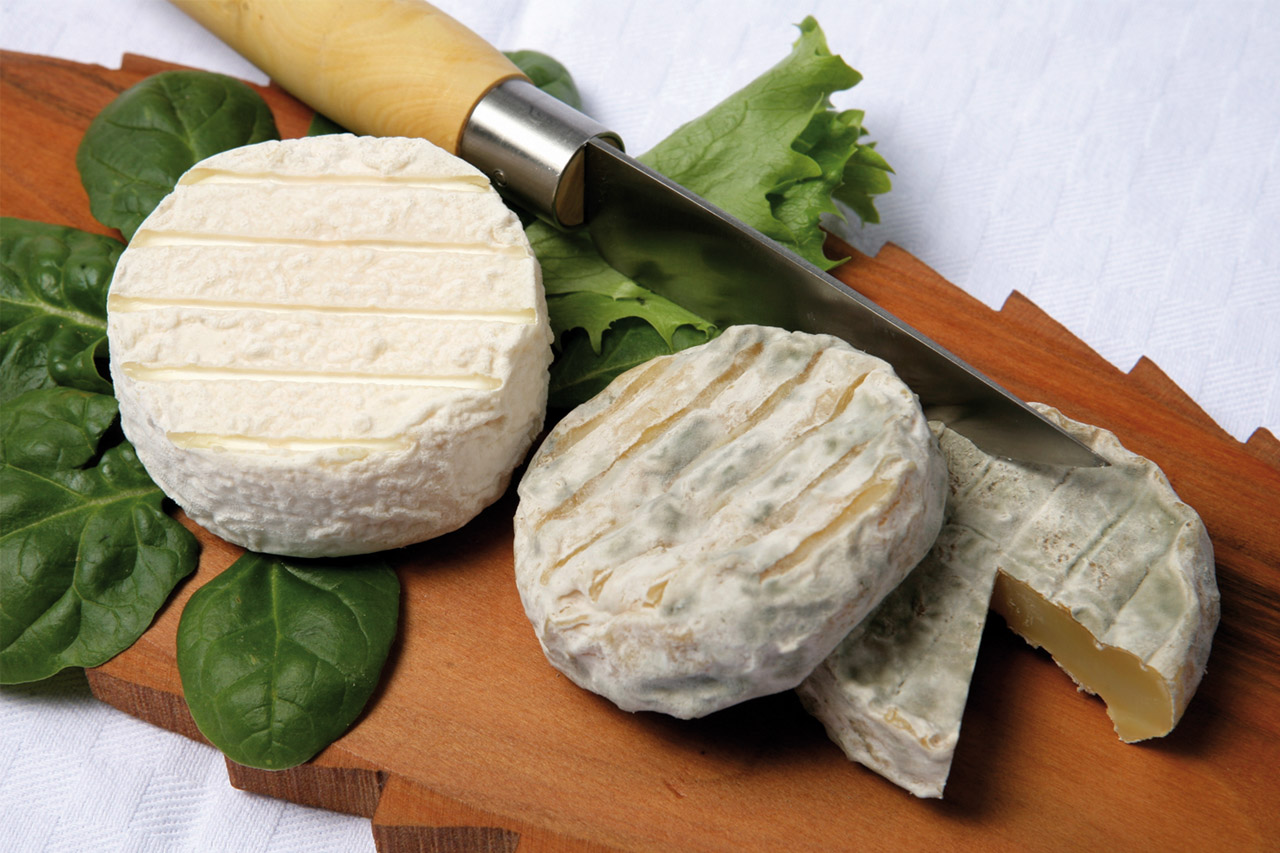
Pélardon PDO's shape is like a small disk with rounded borders and measures from 60 mm to 70 mm diameter and from 22 mm to 27 mm height. It weighs about 60 grams. The paste colour goes from white to ivory; it is homogenous and smooth. With long ripening periode, the texture can become friable. A Pélardon PDO develops goat's milk flavour and a slight aftertaste of walnut.
History
The Pélardon PDO origins are very ancient. Pliny mentioned this cheese in his works, calling it Péraldou, which name comes from pèbre (pepper), due to its piquant taste when it is well matured. Over the centuries, this cheese became more and more famous and reached its best fame in the 1970s, when the new producers expanded its production.
Gastronomy
Pélardon PDO must be conserved in the least cold compartment of the refrigerator wrapped into its original package or into a sealed box. Before eating it, it is suggested to leave it at room temperature for about one hour. It is tasted at room temperature or used to prepare different warm dishes. One of the most popular recipe is to wrap the cheese into breadcrumbs, roast it in the oven with drops of olive oil and serve it with fresh green salad. It is perfect with Languedoc wines like Saint-Chinian, Minervois, Faugères and Coteaux du Languedoc.
Marketing
The product is sold as Pélardon PDO. It is marketed whole.
Distinctive Features
Pélardon PDO is one of oldest and most famous French cheeses made from goat's milk and still produced with traditional methods. The breeders have to keep the goats outside to graze for at least 210 days a year in order to respect the EU specification.