
Description
The Nieheimer Käse PGI is a cheese from cow's milk, with a low content of fat but rich in proteins, made from skimmed milk curd and salt, with the possible addition of Carum carvi, a particular aromatic plant.
Production Area
The production area of Nieheimer Käse PGI is located the municipal area of Nieheim, in the Höxter district, a governmental area of Detmold, in the federal state of North Rhine-Westphalia.
Production Method
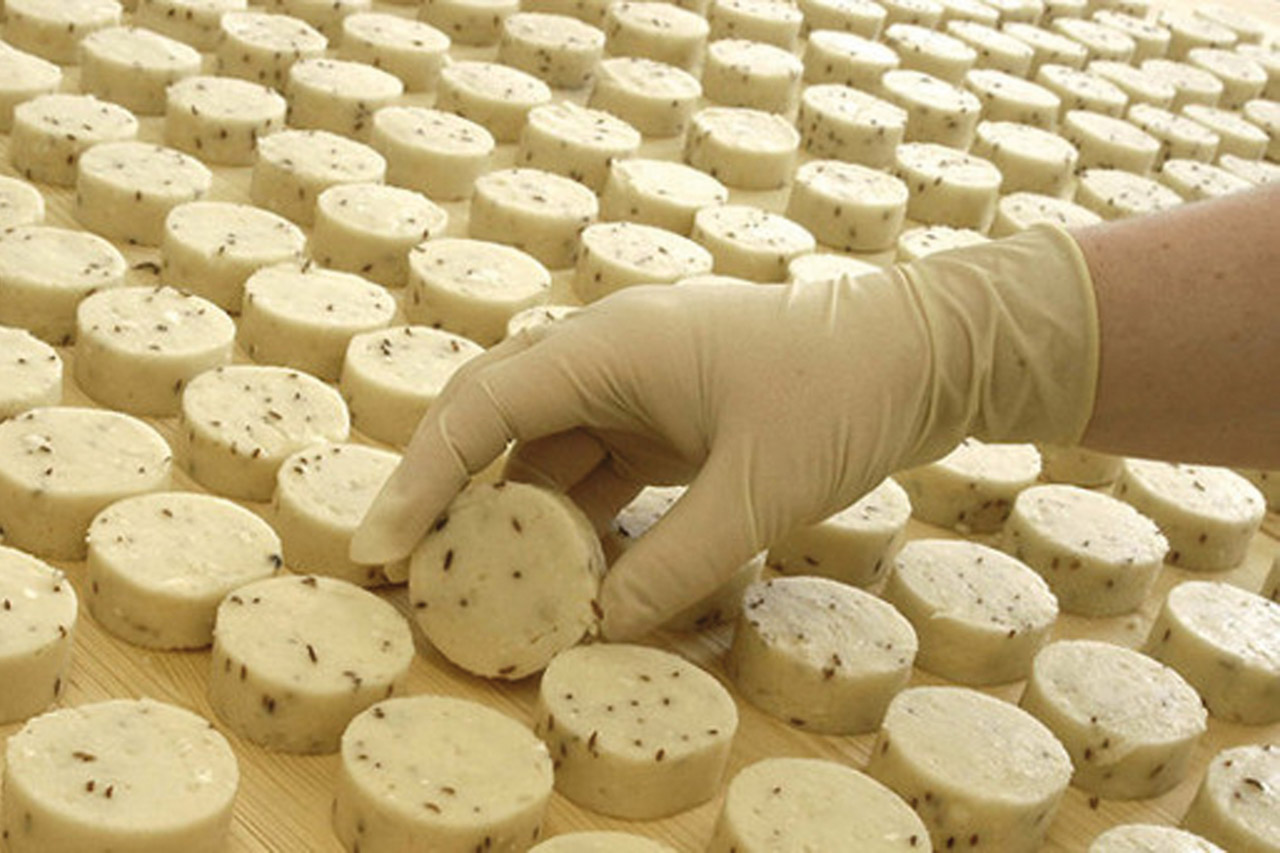
Nieheimer Käse PGI is obtained from processing 100% cow's milk dry curd. The curd, which is finely minced and put in cases, rests for about three to five days, depending on the air's temperature and humidity, in seasoning rooms. When ripe, meaning that the dough reaches the typical yellowish tone, it is mixed with salt and, sometimes with Carum carvi, until the achievement of smooth dough. Small rolls with a diameter of between 4 and 4.5 cm are obtained from the dough and then they are cut in pieces with a variable width, from 2 to 2.5 cm. Later, the single pieces have to cool on appropriate shelves and then packed.
Appearance and Flavour
Despite there also other types, in general, Nieheimer Käse PGI has a cylindrical shape with a diameter of between 4 and 4.5 cm, a height of between 2 and 2.5 cm and a weight of between 32 and 37 gr. The surface is smooth and free from roughness, yellowish tending to grey-green in colour and sometimes covered with hop leaves, which are often used to pack the product. When cut, the surface is smooth, compact and regular, sometimes covered with carum carvi, which is used to give it an aromatic hint. The consistency can be more or less hard and makes the product respectively easy to slice or ideal for grating. Its rich, strong and spicy flavour is typical.
History
The cheese from acid milk is one of the rare palaeo-Germanic inventions in the diary industry. Nieheimer Käse became a local speciality already at the beginning of the 19th century. The cheese stood out due to the peculiar production and ripening methods which have been passed on from generation to generation. Indeed, it was famous on the cheese markets of Nieheim in the 1920s and 1930s. Amongst the written documents, the Landwirtschaftliche Zeitung für Westfalen-Lippe of 1857 praised the qualities of this cheese, whilst there is a confirmation of its peculiarity in the Manual of the cheese's technique of 1884, Die Warte, and the Molkerei- und Käsereizeitung.
Gastronomy
#N/A
Marketing
The product is sold as Nieheimer Käse PGI. It is packed in special breathing bags. The packaging can include also an additional protection layer of hop leaves which has to be mentioned on the label.
Distinctive Features
Nieheimer Käse PGI owes its peculiar organoleptic features to the peculiar ripening process, which is based on the use of bacteria and acid curd's yeast without adding any other cultures and all that makes it unique.