



Description
Hajdúsági torma PDO are the roots of the regional variety of Armoracia rusticana selected in the Hajdúság region through propagation by root cuttings. The product of the plant for human consumption is the root, or rhizome, which develops from the thickening of the preceding year's tap roots used for propagation.
Production Area
Hajdúsági torma PDO is produced the Hajdú-Bihar county in the municipalities: Debrecen (Debrecen-Haláp, Debrecen-Bánk), Létavértes, Újléta, Kokad, Álmosd, Bagamér, Vámospércs; Hosszúpályi, Monostorpályi, Nyírábrány, Nyíracsád, Nyírmártonfalva, Nyíradony.
Production Method
Hajdúsági torma PDO is rendered unique by the special ridge planting method. Planting takes place between the last 10 days of March and the end of May. Planting is always carried out manually: using a specially shaped planting iron, the cuttings are placed vertically in the soil, 3-4 cm below the surface. In 3-4 weeks after planting - when growth appears - a shoot selection is performed and the shoot that is the most vigorous is retained and the rest are removed together with any collar roots. This is how each plant will have a "single head". An adequate quality and quantity of the plant is obtained through irrigation (using the flooding or the drip irrigation methods). Harvesting starts in mid-October and is usually completed by the first frosts. The plant can be harvested also in spring. After the harvesting the roots are pulled out manually and left to dry for a few days. Thereafter a commercial product is prepared from the produce as required by the buyer. The soil is removed from the product along with other dirt, the leaves are removed and then the tap roots suitable for propagation are collected.
Appearance and Flavour
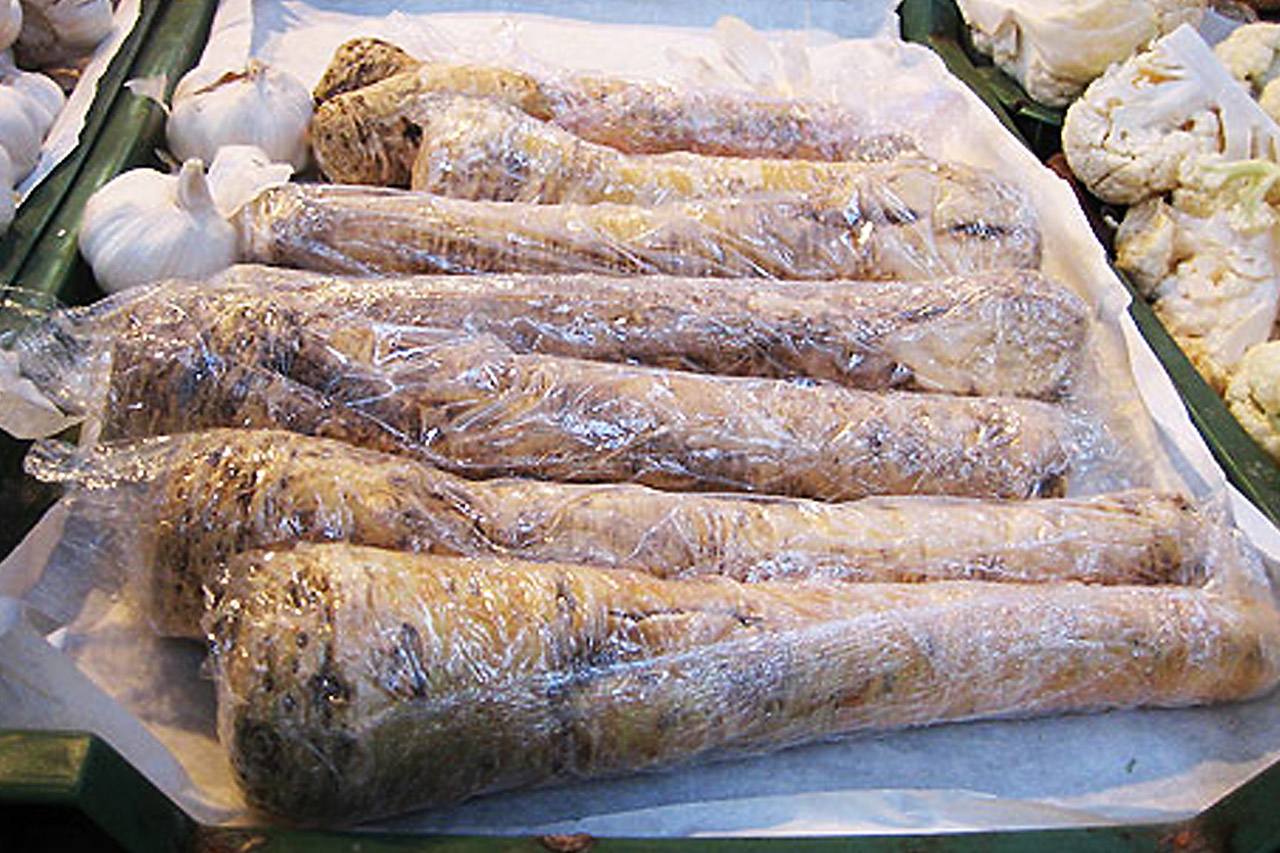
Hajdúsági torma PDO has a 3-4 cm growth on the root cutting, which is called the "head"; it has a cylindrical body of 1,5-5 cm in diameter and 20-35 cm in length. It has thick, dark green, lush foliage twisting in its upper third section, the straight, cylindrical, light brown rhizome and the bone-white flesh. Its taste is never woody and its relatively low allyl isothiocyanate content causes its distinctive hotness, which - by analogy with mild-noble paprika - is also called "noble-hot".
History
The horseradish brought to the Carpathian basin by the ancient Magyar tribes and the native horseradish found here were hybrids of wild varieties. Records of its production go back to the 17th century; it may have arrived in the Hajdúság region in the early 19th century. Horseradish production started to grow particularly in the late 1800s and the early 1900s in this region. Prior to the turn of the century, in the Hajdúság region almost everybody's garden had some amount of horseradish as a perennial plant. After the turn of the century, in the early 1920s the vineyard manager of Bagamér in the Várad chapter, Gábor Szilágyi ordered some "tasty, noble" horseradish from Austria and acclimatised it.
Gastronomy
#N/A
Marketing
The product is sold as Hajdúsági torma PDO in the Classes I, II, III and IV. The nutritional content qualities of the various categories are identical, the only difference is in the appearance of the product. Class I horseradish is used exclusively for consumption as a fresh vegetable, while the other classes provide raw materials primarily for industrial processing. In the case of the Raschel sacks, Class I, II, III and IV products are packaged in green, red, yellow and green sacks, respectively. The product of carved quality is placed in yellow sacks while the root quality product is placed in sacks of any colour.
Distinctive Features
The ridge planting production method, which has developed over decades, differs from the mechanised, slanted method of planting applied in other regions of Europe, the Hajdúsági torma PDO can therefore be clearly distinguished by its appearance from horseradishes produced using other production techniques.